Three Rivers, Connecticut
I Know This Much Is TrueThree Rivers, Connecticut is the Birdsey family’s hometown and the novel’s central local landscape, where intimate family histories unfold beside civic institutions, the Sachem River, and places marked by older histories of settlement and displacement. The town is presented not as an abstract backdrop but as a network of recognizable routes and buildings: the library, the state hospital, the family’s brick duplex, and familiar sites passed in ordinary drives. Revisited across generations, those places make Three Rivers a map of memory as well as a setting for action.
Setting and Geography
Three Rivers State Hospital stands on the southern edge of town, reached by turning off the John Mason Parkway, a four-lane highway running toward the Connecticut shoreline. The hospital property is bordered by the Sachem River to the rear, the town fairgrounds to the north, and sacred Wequonnoc burial grounds to the south. These specific boundaries place a major institution within a landscape that also holds the town’s recreation grounds, a river, and a continuing Indigenous presence. The geography resists reducing the hospital to an isolated enclosure: it is embedded in a larger local territory with histories and meanings of its own.
The hospital grounds had also been a place of work for the twin brothers. In the summer of 1969, while home from their freshman year at college, Dominick Birdsey and Thomas Birdsey were seasonal employees who mowed and trimmed the small Indian graveyard. Their employment connects the brothers’ ordinary return to town with the burial ground beside the institution. The recollection gives the location a layered chronology: the same landscape belongs to their youthful summer labor and to Thomas’s later institutional life.
Family History and the Built Town
The Birdsey family’s home on Hollyhock Avenue is part of Three Rivers’ physical and social history. Domenico Onofrio Tempesta, Dominick’s maternal grandfather, emigrated from Sicily to America in 1901. Through thrift and hard work, he bought a half-acre lot from a farmer’s widow and became the first Italian immigrant to own property in Three Rivers, Connecticut. He built the brick Victorian duplex on Hollyhock Avenue with his own hands; it became the home where his daughter, Ma, lived all her life and where the twins grew up.
The house therefore records more than a family’s residence. Its construction embodies Domenico’s economic ascent and the foothold in property that he secured for his family. The stories Ma told about him reinforced his authority within the household, while the duplex itself gave that authority a lasting material form. The novel links immigrant achievement to domestic power: the building is shelter and inheritance, but it also stands within a family shaped by a stern patriarch whose word governed the home.
Public and Institutional Places
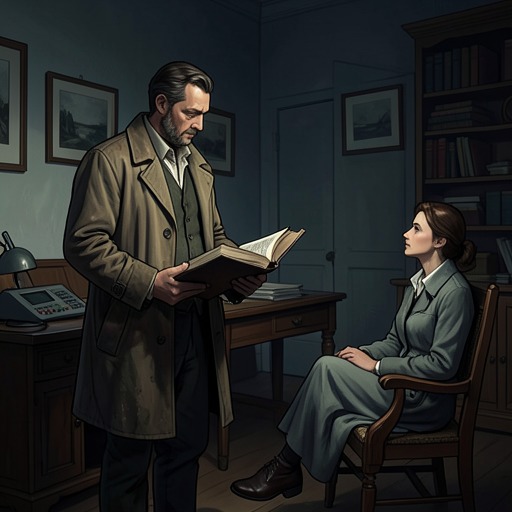
The Three Rivers Public Library is one of the town’s public interiors, but it is also the site of a defining crisis in the twins’ story. On the afternoon of October 12, 1990, Thomas entered the library, went to a rear study carrel, and prayed before the act he understood as a sacrifice. Theresa Fenneck, the children’s librarian officially in charge while the head librarian attended a meeting in Hartford, approached him because his prayer could be heard from the front desk. She told him to lower his voice or leave, and said that someone who wanted to pray should go to a church rather than the library. The scene brings Thomas’s private religious conviction into conflict with the library’s ordinary public rules.
The town’s state hospital provides another institutional setting, closely connected to the family’s routine. Before the library crisis, Dominick’s Sunday visits followed a regular pattern: he signed Thomas out of the hospital’s Settle Building, took him to lunch, visited their stepfather or went for a drive with him, and returned him before supper. In April 1991, the Psychiatric Security Review Board reversed its earlier decision and transferred Thomas to his family’s custody, while strongly advising placement in a fully staffed, fully secured nonforensic psychiatric hospital. The reversal changed the brothers’ relationship to institutional care, but the Board’s recommendation made clear that release from custody did not remove the need for intensive support.
Routes, Memory, and Civic Life
Three Rivers is experienced through repeated journeys as much as through fixed addresses. When Dominick later drove through town with Ray in a vehicle called False Teeth, the route passed the construction site for the new casino, the state hospital, and the McDonald’s where Thomas had eaten a Happy Meal four days earlier. They crossed the Sachem River Bridge and continued through the middle of town. A computer store along the way had once been the Paradise Bakery, where Ray used to buy crullers for the twins after church before taking them to Wequonnoc Park. The drive layers present development over remembered family routines, so that a changed storefront can bring an earlier version of the town back into view.
The town also provided a platform for Domenico’s public standing. He joined the Elks and Knights of Columbus, became an elected officer in Sons of Italy, helped Republicans register Italian voters, and served on the city planning commission, where he was the first Italian in Three Rivers history. His growing civic activity brought frequent requests for his help and made his name familiar beyond the Italian community. This public prominence echoes his earlier achievement as the town’s first Italian immigrant property owner, connecting a family’s arrival and economic foothold with participation in local institutions.
Narrative Significance
The novel’s recurring places make Three Rivers legible through accumulation. A river, a graveyard, a family duplex, a library, and a hospital are not interchangeable scenery: each holds a different relation to work, inheritance, public order, memory, or care. The town’s geography lets the narrative place family events beside civic and historical contexts without separating them into unrelated worlds. The brothers’ labor at the burial ground, Thomas’s confrontation with library rules, and the family’s repeated journeys between home and hospital all belong to the same local map.
That map also carries change without erasing what came before. The casino construction site appears beside the state hospital, while the former Paradise Bakery survives in Dominick’s recollection as a childhood destination. Domenico’s property and civic roles mark one generation’s efforts to establish a place in town; later drives and institutional encounters show how the next generation inherits its streets and buildings as memory-laden surroundings. Three Rivers thus functions as both a home and an archive, holding together the family’s public presence, private losses, and returning past.